PTMW is an OEM manufacturer of engineered steel and aluminum enclosures, based in Topeka, Kansas, with a second plant in Manhattan. Their work ends up in places most people never see: traction power substations, train control rooms, switchgear, data center equipment housings, and energy storage enclosures for railroads, hyperscalers, utilities, and telecom.
They are family-owned, WBENC-certified as a woman-owned business, and hold ISO 9001, AISC 207, and CSA A660. Roughly 375 people work there, and the company is in the middle of a large expansion across both Kansas sites.
What makes them unusual is that they do not only build to print. An in-house engineering team produces fully engineered solutions, including PE stamping for state and local compliance. That is the part that generates paperwork.
Every enclosure PTMW ships is accompanied by a submittal packet: the drawings, specifications, and certification documents that prove the unit is what the contract says it is. The bill of materials defines what goes in that packet, and a single project can carry hundreds of line items, each with its own document, revision, and vendor.
Assembling that by hand creates predictable problems:
Active Logic built a project and document system that takes a bill of materials in and produces a finished, ordered packet out, with the exceptions surfaced rather than buried.
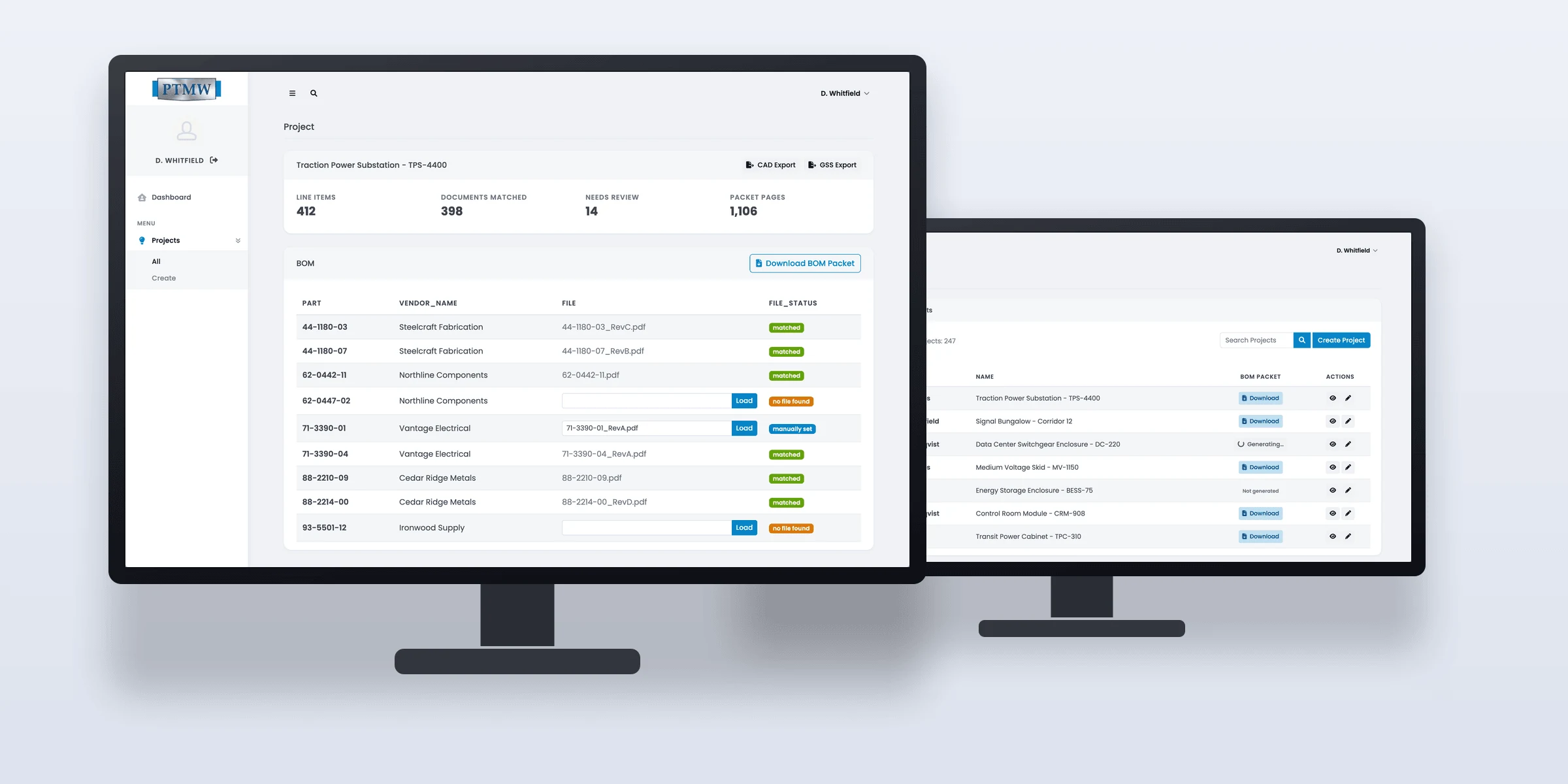
A project starts by importing its bill of materials. Each line is matched against the document library and given an explicit state: matched, not found, or manually set. The engineer sees the exceptions as a short list instead of auditing hundreds of rows, and can resolve any line in place.
Once the lines resolve, the system assembles the documents into a single ordered packet in the structure the deliverable requires. Generation runs in the background so a large project does not tie up the person who started it.
Finished packets move to their destination over SFTP rather than by hand, and the same project data drives CAD and GSS exports, so the document set and the engineering systems stay in agreement.
Built on Laravel with a Vue front end, and delivered by a team of five senior engineers over an eleven-month build.
The system is in production. Document assembly moved from a manual task that scaled with headcount to one that scales with the software, and the exceptions that used to be found at submittal are now visible while there is still time to fix them.
It is not a glamorous system. It is the kind that quietly removes a constraint on growth, which for a manufacturer adding two plants' worth of capacity is the point.
Document assembly, BOM workflows, and ERP-adjacent systems are exactly the kind of work senior engineers should own. Tell us where yours breaks down.
